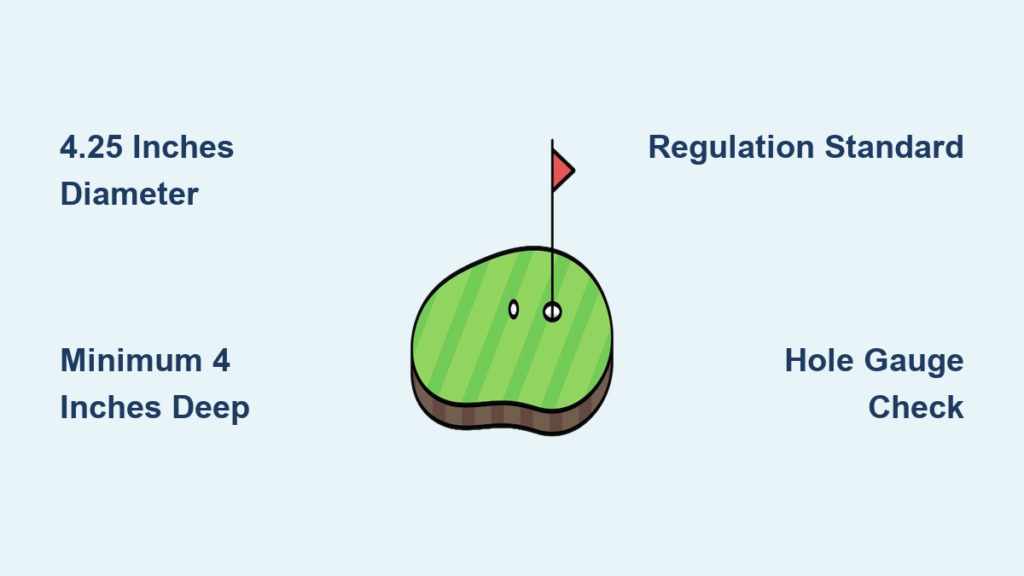
Every golfer has stood over a short putt, staring down at the cup, wondering how such a tiny target could feel so far away. Despite the nerves that come with a must-make putt, one element never changes on any course: the size of the golf hole. Officially, a golf hole measures 4.25 inches in diameter and must be at least 4 inches deep. This standard is enforced by the Rules of Golf, governed jointly by the USGA and The R&A. From your local municipal course to the most prestigious major championship venues, every cup you encounter meets this exact specification.
Knowing the precise golf hole dimensions affects more than just curiosity. It shapes green design, hole placement strategy, and even putting technique. A 4.25-inch target may sound generous, but on a fast, sloping green, the effective capture area shrinks fast. In this guide, you will learn the history behind the standard, the rules that enforce it, how holes are cut and maintained, and what happens when dimensions deviate, even slightly.
Why 4.25 Inches Became the Universal Standard
The Accidental Origin at Royal Musselburgh
The 4.25-inch golf hole size was not the product of scientific study. In the early days of golf, hole sizes varied based on whatever tools were available. That changed in 1828 at the Royal Musselburgh Golf Club in Scotland. Groundskeepers used a circular iron cutter originally designed for drainage work, and that tool happened to measure 4.25 inches in diameter. The size proved practical and quickly caught on.
When the R&A codified the first official rules in 1891, the 4.25-inch measurement was formally adopted. The USGA followed suit, creating global consistency. What started as a happy accident became the permanent standard that defines golf hole dimensions worldwide.
Could the Standard Ever Change?
Despite debates about difficulty and accessibility, both the USGA and R&A have no plans to alter the regulation size. Changing it would disrupt equipment standards, course architecture, and player expectations built over more than a century. While novelty formats like Topgolf and mini-golf use larger cups, traditional golf remains firmly committed to the 4.25-inch standard.
Official Rules Governing Golf Hole Dimensions

USGA and R&A Specifications
Rule 13.2a(2) of the Rules of Golf establishes two key criteria for every golf hole:
- Diameter: Exactly 4.25 inches, with a manufacturing tolerance of no more than ±0.125 inches.
- Depth: A minimum of 4 inches, though most holes are cut deeper to prevent balls from bouncing out.
The hole must also be lined with a sleeve, typically metal or plastic, set flush with the green surface. This sleeve stabilizes the edges, supports clean cutting, and allows for consistent relocation.
Enforcement on Championship Courses
On PGA Tour venues and major championship setups, officials verify golf hole dimensions before play begins. A hole gauge confirms each cup meets the 4.25-inch standard. If a hole is found to be undersized or poorly cut, it must be corrected immediately. Even a minor deviation can affect ball capture, particularly on fast Stimpmeter-rated greens.
How Golf Holes Are Cut and Maintained
The Hole-Cutting Process
Greenkeepers use a turf hole cutter, a cylindrical tool with sharp edges, to extract a plug of turf at the regulation size. The standard cutter matches the 4.25-inch diameter precisely. The process follows these steps:
- Mark the new hole location, at least 6 feet from the previous spot and 4 feet from the edge of the green.
- Cut the cylinder to a depth of 6 to 8 inches.
- Remove the plug and insert a cup liner.
- Replace the surrounding turf and smooth the edges.
This rotation prevents turf wear and allows the green to recover between hole placements.
Frequency of Hole Relocation
Most courses relocate holes daily to prevent turf damage and maintain fairness. High-traffic public courses may move holes multiple times per day. Each new position must allow for safe approach shots and avoid weak or unrecoverable spots on the green surface.
Factors That Affect Ball Capture
Green Speed and Effective Hole Size
Even with regulation golf hole dimensions, green speed dramatically influences whether a putt drops. On fast greens measuring 12 or higher on the Stimpmeter, a ball traveling too quickly may lip out even on a center hit. Slower greens offer more margin for error. Research indicates that putts rolling about 17 inches past the hole have the highest capture rate at regulation speed.
The Role of Hole Depth
While 4 inches is the minimum, most cups are cut 6 to 8 inches deep. This added depth prevents balls from popping out on hard impacts, especially on downhill putts. A shallow hole increases bounce-out risk, frustrating players and distorting scoring.
Common Misconceptions About Golf Hole Dimensions
“Some Holes Feel Smaller”
Many players insist certain cups look smaller or fail to catch well-rolled putts. In reality, all regulation holes measure exactly 4.25 inches. The illusion comes from background trees, shadows, slopes, and surrounding turf color. Visual perception, not actual size, creates the impression of a smaller target.
Mini-Golf Uses Different Standards
Miniature golf courses often use larger holes ranging from 6 to 12 inches to accommodate obstacles and casual play. These venues are not governed by USGA rules and serve entertainment rather than competitive play.
Equipment Used to Verify Golf Hole Dimensions

Hole Measurement Tools
Superintendents and tournament officials rely on hole gauges to verify dimensions. These L-shaped tools feature a 4.25-inch opening to check diameter and a depth probe to confirm the cup meets the 4-inch minimum. Some digital models provide instant readings for tournament-level precision.
Putting Training Aids
Many putting trainers replicate the exact 4.25-inch size to simulate authentic conditions. Lag putting rings fit around regulation cups, helping players practice speed control. Portable practice greens with regulation-sized holes are popular for indoor and backyard use.
Impact on Golf Course Design
Green Size and Hole Placement Strategy
Course architects design greens with the 4.25-inch target in mind. A typical green ranges from 300 to 1,200 square feet, allowing multiple hole locations across its surface. The minimum safe distance from any edge is 4 feet, ensuring a fair and reachable approach shot.
Strategic Tournament Pin Positions
Championship setups often place holes in challenging positions near slopes, bunkers, or ridges. While the size of the cup never changes, these tricky locations test a player’s precision and make capture significantly harder.
What Happens When Dimensions Are Wrong
Incorrect Hole Size During Play
If a hole is found to be undersized during a round, it is treated as a condition of the course. In casual rounds, it is corrected when noticed. In competition, affected players may be required to re-putt if the error influences play, per Rule 13.1d.
Damage Mid-Round
If a hole collapses or becomes damaged from a cart, an animal, or equipment, the committee may lift and place the ball near the original spot. Play cannot continue with a distorted or compromised cup.
Best Practices for Green Maintenance

Preventing Wear Around the Cup
To extend green health, courses follow strict hole rotation schedules. Each green typically has 10 to 15 viable locations, rotated systematically. Overuse leads to “doughnutting,” a raised ring around the hole caused by repeated ball impacts and foot traffic.
Aeration and Topdressing
Regular aeration and topdressing help turf recover from frequent hole cutting. Sand or soil mixtures are applied to smooth transitions and encourage healthy grass growth around the cup area.
Putting Technique and Regulation Hole Size
Optimal Ball Speed for Capture
Research shows that putts rolling 1 to 2 feet past the hole have the highest chance of dropping. Faster putts reduce the effective capture area due to bounce and skid. Slower putts widen the window for the ball to fall.
The “Make Zone” Concept
Putting coaches define the “make zone” as the distance within which a player should convert nearly every putt. On average, this range falls between 3 and 6 feet, where the 4.25-inch hole appears largest relative to the ball.
The Future of Golf Hole Standards
Technology in Hole Cutting
New tools like laser-guided hole cutters and GPS mapping ensure precise placement and consistent golf hole dimensions. Some advanced courses use sensors in cups to track ball entry speed and angle, supporting better green maintenance.
Adaptive Formats for Beginners
There is ongoing discussion about adaptive golf formats using larger holes to help new players build confidence. While not part of official USGA rules, driving ranges and beginner programs sometimes adopt 6-inch holes to make the game more approachable.
Frequently Asked Questions About Golf Hole Dimensions
What is the official diameter of a golf hole?
The official diameter is 4.25 inches, as specified by the USGA and R&A under Rule 13.2a(2). This applies to every regulation course worldwide.
How deep is a regulation golf hole?
The minimum depth is 4 inches, but most cups are cut 6 to 8 inches deep to prevent balls from bouncing out, especially on fast or downhill putts.
Why are golf holes 4.25 inches wide?
The size originated in 1828 at the Royal Musselburgh Golf Club in Scotland, where groundskeepers used a 4.25-inch drainage cutter. The R&A formalized the standard in 1891.
Do all golf courses use the same hole size?
Yes. Every course governed by USGA or R&A rules must use holes measuring exactly 4.25 inches in diameter, with a tolerance of ±0.125 inches.
Can a golf hole be smaller than regulation?
No. The Rules of Golf prohibit holes smaller than 4.25 inches. If a hole is found undersized, it must be corrected before play continues.
Do mini-golf holes follow the same standard?
No. Mini-golf holes range from 6 to 12 inches and are not subject to USGA regulations. They exist for entertainment and casual play only.
Key Takeaways on Golf Hole Dimensions
The 4.25-inch golf hole has stood as the universal standard for nearly two centuries, shaping every aspect of how the game is played. Its accidental Scottish origin evolved into a precise regulation enforced on every competitive course. Understanding these dimensions helps players appreciate green design, putting strategy, and course setup choices. Next time you step onto the practice green, set up your alignment using regulation measurements and notice how the consistent target affects your speed control and confidence.