

Imagine standing on the first tee with your teammates, knowing that one perfect swing can set the entire group up for success. This is the unique thrill of the shamble format, a popular choice for charity tournaments and corporate outings where teamwork meets individual skill. If you have ever wondered how does a shamble work in golf, the answer lies in its hybrid nature: it combines the best-drive element of a scramble with the individual ball play of stroke play.
In this format, pressure shifts from executing every single shot perfectly to delivering one crucial drive. Once the team selects the best tee shot, every player drops their own ball at that spot and plays the hole out independently. The tension builds as each golfer navigates the fairway, approaches the green, and putts, knowing their individual score will contribute to the final team total.
This guide breaks down the mechanics, rules, and strategies of the shamble. You will learn exactly how the tee shot selection works, how individual scores determine the winner, and how handicap adjustments ensure fair play for teams of all skill levels. Whether you are a tournament organizer or a player preparing for your next event, understanding these rules is essential for success.
Core Mechanics of Shamble Format
The shamble format distinguishes itself from other team golf games through a specific two-phase process. Unlike a standard scramble where the team plays one ball together, or four-ball where the best individual score counts immediately, the shamble requires a collective start followed by individual execution.
Selecting the Best Drive
The process begins identically for every member of the team. All players hit a tee shot from the designated teeing area. Once all drives are complete, the team confers to select the single best position. Criteria for the “best” drive usually include:
- Distance: How far the ball traveled.
- Lie: Whether the ball is in the fairway, rough, or a hazard.
- Angle: The approach angle to the green for the subsequent shot.
Once the team agrees on the optimal drive, that specific location becomes the starting point for the next phase. The chosen spot is marked, and all players prepare to play their second shots from there.
Playing Individual Ball Stroke Play
After the best drive is selected, the team dynamic shifts entirely. From the location of the chosen tee shot, every player places their own ball and plays the remainder of the hole independently.
- Player A hits their own second shot, third shot, and putts.
- Player B hits their own second shot, third shot, and putts.
- Player C and D do the same.
There is no sharing of clubs or putting lines after the tee shot. Each golfer is responsible for their own ball management, rule adherence, and scorekeeping for the rest of the hole. This phase tests individual competency rather than group consensus.
Calculating the Team Score
The final component of the shamble mechanics is the scoring method. Since every player completes the hole with their own ball, the team generates multiple scores per hole (e.g., four scores for a four-person team).
To determine the team score for that specific hole, you count only the lowest score among the teammates.
- Example: On a par 4, if Player A scores 4, Player B scores 5, Player C scores 4, and Player D scores 6, the team score is 4.
- The higher scores are discarded for the team total but remain on the individual scorecards for handicap tracking.
This “best ball” scoring at the end of the hole encourages aggressive play. If one player makes a mistake after the tee shot, a teammate can still salvage the hole with a strong individual performance.
Handicap Adjustments for Fair Play
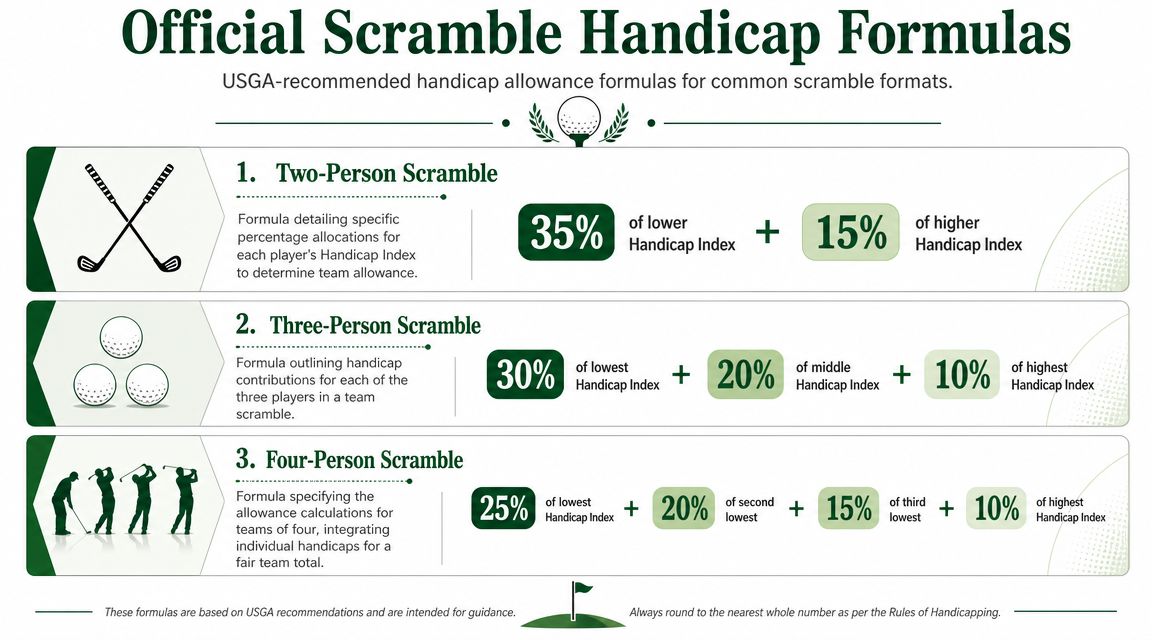
One of the most critical aspects of organizing or playing in a shamble is ensuring fairness across teams with varying skill levels. Because the format allows teams to utilize the best drive and the best individual score, raw stroke play totals can skew heavily in favor of low-handicap groups. To counter this, specific handicap allowances are applied.
Two-Person Team Allowances
When organizing a shamble with two-person teams, the competition committee typically applies a percentage reduction to each player’s Course Handicap before calculating the team net score.
- Standard Allowance: 75% of each player’s Course Handicap.
- Calculation: If Player A has a 10 handicap and Player B has a 20 handicap, their combined raw handicap is 30. Applying the 75% allowance reduces the team handicap to 22.5 (rounded according to local rules).
This reduction accounts for the fact that the team benefits from two chances to hit a great drive and two chances to post a low score on every hole. Without this adjustment, teams with even moderate handicaps would consistently outperform the course rating.
Four-Person Team Allowances
Larger teams introduce more variables, increasing the likelihood of a perfect drive and a low individual score. Consequently, the handicap allowance decreases as team size increases to maintain competitive balance.
- Standard Allowance: 65% of each player’s Course Handicap.
- Impact: In a foursome, the probability of finding the fairway and having one player shoot under par is significantly higher. The 35% reduction helps level the playing field against lower-handicap duos or threesomes.
Why Percentage Reductions Matter
Using 100% of handicaps in a shamble format often results in artificially low team scores that do not reflect true difficulty. The percentage reductions serve several purposes:
- Competitive Integrity: Prevents high-handicap teams from having an unfair advantage due to the “best of” nature of the game.
- Pacing: Encourages players to focus on their own game rather than relying solely on a low-handicap partner to carry the score.
- Prize Distribution: Ensures that flighted prizes (awards for different skill brackets) are distributed based on genuine performance relative to the format’s difficulty.
Tournament organizers should clearly communicate these allowances in the player guide so participants understand how their net scores are derived.
Step-by-Step Gameplay Procedure
Understanding the theory is helpful, but knowing the exact sequence of actions on the course is vital for smooth play. A typical shamble hole proceeds through a strict chronological order to prevent confusion and speed up play.
Teeing Off Sequence
- Preparation: All team members tee up their balls. It is courteous to wait until everyone is ready to minimize distractions.
- Execution: Players hit their drives in an agreed-upon order (often based on honors or simply rotating who goes first).
- Observation: Team members should watch each other’s shots carefully, noting not just distance but also the lie and the angle into the green.
- Selection: Once all drives are hit, the team gathers to choose the best one.
- Tip: Do not rush this decision. A slightly shorter drive in the center of the fairway is often better than a long drive buried in thick rough or behind a tree.
Transitioning to the Second Shot
Once the drive is selected, the physical transition must be handled correctly to avoid penalties.
- Mark the Spot: Use a tee or a coin to mark the exact location of the chosen drive.
- Measure One Club Length: In many shamble formats, players are allowed to place their ball within one club-length of the selected spot, no closer to the hole. However, strict rules may require playing from the exact spot. Always verify local rules before the round.
- Drop or Place: Players place or drop their own balls at the designated area.
- Clear the Area: Ensure all other balls from the tee shot are picked up to avoid confusion.
Completing the Hole Individually
From the second shot onward, the group splits conceptually, even if they walk together.
- Independent Decisions: Each player chooses their own club, target, and strategy for the approach shot.
- Separate Putts: On the green, players putt out their own balls. There is no “gimme” putting for the team; every putt counts for that individual’s score.
- Recording Scores: Each player records their own gross score on the card. At the end of the round, the lowest scores per hole are tallied to create the team total.
Strategic Tips for Shamble Success
Winning a shamble requires a different mindset than traditional stroke play. Since the team only counts the best score, risk management and role definition become paramount.
Optimizing the Tee Shot Strategy
The tee shot is the only time the team acts as a single unit. Therefore, the strategy here should prioritize position over pure distance.
- Fairway First: A 250-yard drive in the fairway is almost always superior to a 280-yard drive in the trees. The goal is to give every player a clear look at the green for their second shot.
- Avoid Hazards: If a bunker or water hazard guards the landing zone, aim away from it. A safe drive keeps the team out of trouble before the individual phase begins.
- Angle Analysis: Choose the drive that offers the best angle to the pin. If the pin is on the left, a drive from the right side of the fairway might offer a better approach line, even if it is slightly shorter.
Managing Individual Risk
Once playing the individual ball, players should adjust their risk tolerance based on their teammates’ performances.
- The Aggressive Approach: If your teammates are struggling on a hole (e.g., they are in the rough or have poor lies), you may need to take higher risks to post a low score.
- The Conservative Approach: If a teammate has already hit a great approach shot and is likely to make par or birdie, you can play conservatively to avoid a double bogey that could ruin the team’s momentum, although remember only the best score counts.
- Putting Pressure: On the greens, if a teammate has a difficult putt for par, your focus shifts entirely to making your own par or better. You do not need to match them; you need to beat or tie their potential score.
Communication and Morale
Since the team score relies on the lowest individual score, maintaining high morale is a strategic asset.
- Encouragement: A player who feels supported is more likely to recover from a bad shot and post a good score.
- Honest Assessment: Be realistic about the best drive. Don’t choose a drive just because it was hit by the best player on the team if another drive is objectively in a better position.
- Role Clarity: Understand that everyone contributes. Even the highest handicap player can win the hole for the team with one great individual effort after the tee shot.
Common Mistakes to Avoid

Even experienced golfers can stumble in a shamble format due to confusion over the rules or poor strategic choices. Avoiding these common pitfalls can save strokes and prevent disqualification.
Confusing Shamble with Scramble
The most frequent error is treating a shamble like a scramble.
- The Mistake: After selecting the best drive, players continue to choose the best shot for every subsequent stroke (approach, chip, putt).
- The Consequence: This leads to incorrect scores and potential disqualification. In a shamble, only the tee shot is shared. All other shots must be played individually.
- The Fix: Remind your team repeatedly: “Best drive, then play your own ball.”
Poor Drive Selection
Teams often choose the longest drive without considering the lie.
- The Mistake: Selecting a drive that is 300 yards out but sitting in deep rough or behind a tree.
- The Consequence: Every player on the team now faces a difficult second shot from a terrible position, likely leading to high scores for everyone.
- The Fix: Prioritize the fairway. A shorter shot from the short grass gives every player a fighting chance to make par or birdie.
Ignoring Handicap Allowances
Players often forget that handicap adjustments are part of the game calculation.
- The Mistake: Calculating the team score using 100% of handicaps or failing to apply the 65%/75% rule.
- The Consequence: Incorrect winner determination and unfair prize distribution.
- The Fix: Verify the tournament rules regarding handicap percentages before the round starts and double-check the math on the scorecard before submission.
Slow Play During Selection
The process of choosing the best drive can become a bottleneck.
- The Mistake: Debating the merits of every drive for several minutes while groups behind wait.
- The Consequence: Slow play penalties and frustration from other competitors.
- The Fix: Establish a quick decision protocol. If two drives are very close, pick the one hit by the player whose turn it is to hit first next, or simply choose the one in the fairway immediately.
Variations and Rule Clarifications
While the core rules of a shamble are consistent, local committees often introduce variations to suit specific event goals. Understanding these nuances is crucial for both organizers and participants.
Modified Drive Selection Rules
Some tournaments alter how the second shot is taken.
- Standard Rule: Play from the exact spot of the chosen drive.
- Variation: Allow players to drop within one club-length of the chosen spot, no closer to the hole. This speeds up play and prevents congestion if multiple balls are close together.
- Variation: Some formats require the ball to be played from the fairway even if the chosen drive is in the rough, though this is less common and should be explicitly stated in local rules.
Scoring Format Adjustments
While the standard is “lowest score counts,” variations exist for larger events.
- Two-Best-Ball Shamble: In very large fields or specific charity events, the team might count the two lowest scores instead of just one. This reduces the pressure on a single player to carry the hole.
- Maximum Score Cap: To speed up play, some events implement a “double par” cap. If a player hasn’t finished the hole by double par, they pick up, and the score is recorded as the cap.
Team Composition Rules
Organizers may dictate how teams are formed to ensure fairness.
- Flighted Teams: Teams are grouped by combined handicap ranges.
- Random Draw: Players are assigned to teams randomly to prevent “stacking” teams with all low-handicap players.
- Captain’s Choice: Similar to a Ryder Cup format, where a captain selects the lineup, though this is rarer in casual shambles.
Always review the specific “Notice to Players” or local rules sheet provided at the registration desk, as these variations supersede general conventions.
Frequently Asked Questions About Shamble Golf Format
Can we use a mulligan on the tee shot?
Unless the tournament specifically sells mulligans as a charity fundraiser, standard rules of golf apply: no mulligans. Every drive counts toward the selection process. If a player hits a terrible shot, it simply isn’t chosen as the team drive.
What happens if all tee shots go out of bounds?
If every member of the team hits their tee shot out of bounds or into an unplayable lie, the team must proceed under standard stroke play rules for the worst lie, or re-tee with penalty strokes as applicable to each individual player. They then play their second shots individually from there. There is no “free” retry for the whole team.
Do we putt together in a shamble?
No. While you walk to the green together, every player must putt their own ball into the hole. You cannot concede putts for the team score; the actual number of strokes taken by the individual determines if they post the low score for the team.
Is a shamble better than a scramble for charities?
It depends on the goal. Scrambles are faster and allow high-handicap players to feel like pros on every shot. Shambles, however, require more individual skill and often result in slightly longer rounds, but they provide a more accurate reflection of individual ability while still offering the team support element. Many organizers prefer shambles because they feel more like “real golf” while remaining accessible.
How do we handle a tie in a shamble tournament?
Tie-breaking procedures should be defined in the local rules. Common methods include comparing the sum of the back-nine scores, comparing the sum of the last six holes, or hosting a sudden-death playoff involving one representative from each tied team playing a hole.
Key Takeaways for Mastering the Shamble Format
By understanding how does a shamble work in golf, you can approach your next tournament with confidence. Focus on hitting quality tee shots in fairway positions, play your own ball with integrity from the second shot onward, and remember that only the lowest individual score counts for the team. Verify the handicap allowances (75% for pairs, 65% for foursomes) before your round so there are no surprises on the scorecard. Whether you are chasing a trophy or simply enjoying a day on the course with friends, the shamble format offers a perfect blend of individual challenge and team camaraderie.





