
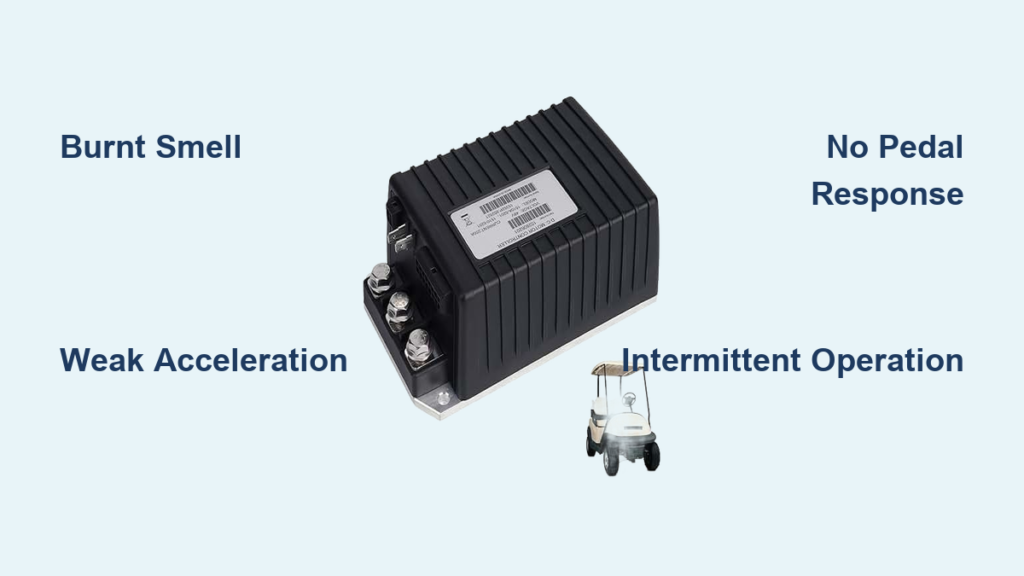
A golf cart that sputters, loses power on hills, or refuses to start often points to one component: the motor speed controller. This unit regulates battery power flowing to the motor, making it the brain of any electric cart. When it fails, performance drops fast, and guessing at a fix can lead to wasted money or unsafe operation.
This guide covers golf cart controller repair with a focus on Curtis controllers, the industry leader for electric vehicle controls. You will learn how to spot early failure signs, understand why certified reconditioning matters, and protect your cart from future breakdowns.
Why Certified Curtis Repair Matters
Curtis Instruments has authorized only one facility in the Americas to perform factory-spec controller repairs: Flight Systems Industrial Products (FSIP) in Carlisle, Pennsylvania. This exclusivity is not a marketing claim. It reflects access to proprietary software, original schematics, and proprietary test protocols.
What Makes FSIP the Authorized Choice
FSIP operates a 45,000 square foot technical service facility dedicated solely to electric vehicle controllers. Their operation is the largest and most specialized of its kind in North America. Every remanufactured unit is upgraded to the latest revisions, load tested to maximum voltage, and inspected for safety and performance.
No other company holds the advanced competencies required to meet Curtis factory specifications.
The Risk of Third-Party Repairs
Some vendors online advertise Curtis-compatible service or remanufactured units. Curtis explicitly warns against these alternatives. Unauthorized services typically cannot meet factory performance benchmarks because they lack access to proprietary tools and data.
Using an uncertified repair risks premature failure, unsafe operation, and voided warranties on connected components.
Common Signs Your Controller Is Failing

Catching controller trouble early prevents complete breakdowns. Most operators wait until the cart will not drive at all, yet symptoms show up well in advance.
Power Loss and Weak Acceleration
A sluggish cart that struggles uphill or hesitates under throttle often signals a controller failing to deliver steady current. Before suspecting the controller, rule out low battery charge, as the symptoms can overlap.
Intermittent Operation
A cart that starts sometimes but cuts out under load points to degrading internal circuitry. Watch for erratic LED indicators on the controller, a common visual cue for this issue.
No Response from the Pedal
When pressing the accelerator produces nothing, the controller may be dead. Test microswitches, the key switch, and the solenoid first. If those components function correctly, the controller is the likely fault point.
Burning Smell or Scorch Marks
A burnt odor or visible charring on the controller casing signals serious internal damage. Disconnect the battery immediately and stop using the cart to prevent fire risk.
How FSIP Rebuilds Curtis Controllers
FSIP follows a strict remanufacturing process designed to restore factory performance, and in many cases, exceed original reliability through design updates.
The Remanufacturing Process
Each controller passes through a multi-step procedure including:
- Intake inspection with serial logging and damage assessment
- Complete disassembly and housing cleaning
- Circuit board evaluation of transistors, capacitors, ICs, and traces
- Replacement of worn or obsolete parts with OEM-grade equivalents
- Firmware upgrade to the latest software version
- Conformal coating application on PCBs for moisture and vibration resistance
- Reassembly with updated hardware and seals
- Load testing under full voltage and current for extended cycles
- Thermal stress monitoring under peak load
- Final certification, sealing, labeling, and shipment prep
Load Testing That Simulates Real Conditions
Local shops may test a controller with a multimeter, but FSIP uses dynamic load banks that replicate real driving. These rigs test systems up to 72V and 500+ amps, validating performance during hill climbs and hard acceleration. This step prevents “works on bench” failures once the controller is installed.
Types of Curtis Controllers Serviced
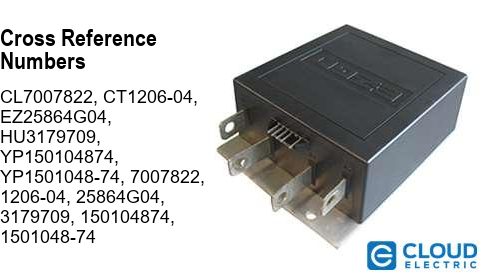
FSIP remanufactures all major Curtis controller categories used in electric golf carts and industrial EVs.
Traction Motor Controllers
These units control forward, reverse, and speed in golf carts and personnel carriers. Common models include the 1206, 1209, 1211, and 1221 series, covering 36V to 72V systems. Many include regenerative braking and programmable acceleration.
Pump and Lift Controllers
Found in utility carts with hydraulic lifts or dump beds, these work alongside traction units to control hydraulic functions precisely.
Power Steering Controllers
Carts equipped with electric power steering use dedicated controllers that reduce steering effort while monitoring system safety.
Battery Indicators and Accessories
Digital displays and discharge indicators integrate with the main controller. FSIP reconditions these units and calibrates them for accurate state-of-charge readings.
Benefits of Professional Reconditioning
Choosing authorized golf cart controller repair delivers value far beyond a quick patch.
Significant Cost Savings
Remanufactured Curtis controllers typically cost 40–60% less than new units while matching original performance, warranty coverage, and lifespan.
Faster Turnaround
FSIP stocks common cores and components, enabling quicker service than waiting for factory-new imports. Standard turnaround runs 3–5 business days from receipt, with rush options available for fleets.
Reduced Environmental Impact
Rebuilding controllers keeps electronic waste out of landfills and conserves raw materials. One remanufactured controller keeps several pounds of e-waste out of the waste stream.
Full Warranty Protection
Every FSIP-reconditioned controller comes with warranty coverage equal to new-unit terms, including defect protection and return shipping diagnostics. This coverage is absent with used or third-party repaired units.
When to Repair and When to Replace
Not every failed controller belongs at a remanufacturing facility. Use this guide to decide.
Repair If:
- The unit is a current-production Curtis model
- The physical casing is intact with no crushing or melting
- Failure occurred during normal operation
- The cart is still in active service
Replace or Upgrade If:
- The controller is obsolete with no remanufacture support
- Severe water or fire damage is present
- You are upgrading to lithium batteries or higher voltage
- Frequent prior repairs suggest systemic issues
Consider upgrading to a newer Curtis model during reconditioning to gain better efficiency and diagnostics.
Preventing Future Controller Failures
Even the best repair fails early if root causes remain unaddressed. Protect your investment with these habits.
Maintain a Clean and Dry Environment
Moisture and dirt rank among the top causes of controller failure. Inspect gaskets and seals regularly. Avoid pressure washing near the controller location and ensure proper venting without rain exposure.
Protect Battery Health
A weak or unbalanced battery pack stresses the controller. Test individual cells monthly, clean terminals, tighten connections, and replace aging batteries before they drag down the system.
Respect Load Limits
Exceeding weight capacity or towing heavy loads overheats the controller. Stay within rated capacity, use lower speeds on inclines, and consider temperature monitors for heavy-use carts.
Schedule Annual Inspections
A yearly check of the controller and electrical system catches minor issues early, especially before peak season. FSIP provides diagnostic reports with every service.
How to Send Your Controller for Service
Getting your Curtis controller repaired through FSIP is straightforward but requires using the official process.
Starting Service in the Americas
- Visit the Curtis Instruments Americas service page
- Select Service and Reconditioning
- Complete the Return Materials Authorization (RMA) form
- Package the controller securely with documentation
- Ship to FSIP in Carlisle, Pennsylvania
Do not ship without an RMA number. FSIP will not process unapproved returns.
International Customers
Customers outside North America should use the Curtis Europe service portal or contact the local Curtis regional office for Asia. All regions use authorized centers following the same remanufacturing standards.
Tracking and Communication
After FSIP receives your controller, you receive email confirmation, a preliminary diagnosis within 24 hours, a repair quote if not under warranty, an estimated completion date, and tracking for the return shipment. You can also call for status updates during processing.
Frequently Asked Questions About Golf Cart Controller Repair
What does a Curtis motor speed controller do in a golf cart?
It regulates power from the battery to the motor, controlling speed, acceleration, and direction. It acts as the brain of the electric drivetrain.
How long does FSIP controller repair take?
Standard turnaround runs 3–5 business days from receipt. Rush service is available for fleet operators who need faster return times.
Can a third-party shop repair a Curtis controller properly?
No. Only FSIP holds Curtis authorization in the Americas. Third-party vendors lack access to proprietary software, schematics, and test protocols, and their repairs do not meet factory specifications.
How much does Curtis controller reconditioning cost?
Remanufactured units typically cost 40–60% less than new controllers while matching original performance and warranty coverage. Specific pricing depends on the model and condition.
What should I do if my golf cart controller smells like it is burning?
Stop using the cart immediately and disconnect the battery. A burnt odor or scorch marks indicates serious internal damage that poses a fire risk. Contact FSIP through the official RMA process.
Does FSIP offer a warranty on reconditioned controllers?
Yes. Every FSIP-reconditioned Curtis controller comes with warranty coverage equal to new-unit terms, covering defects in materials and workmanship.
Final Thoughts on Golf Cart Controller Repair
When a Curtis controller fails, the smartest move is authorized reconditioning through FSIP. Their exclusive status ensures every unit meets factory specifications with the latest firmware, full load testing, and proper certification. Third-party repairs cannot match this standard.
Start by recognizing early warning signs like weak acceleration, intermittent operation, or burnt odors. Use only the official Curtis service portal to initiate an RMA. Once your controller returns, protect your investment with clean operating conditions, healthy batteries, and annual inspections.
For reliable golf cart controller repair, trust the only facility Curtis authorizes in the Americas: FSIP.





