
You step up to the tee on a muggy Florida morning, with humidity at 90% and air thick enough to chew. Your ball doesn’t seem to carry like it does on dry desert days. You’re not imagining it. But here’s the twist: humid air is actually lighter than dry air, meaning your golf ball should fly slightly farther in high humidity. So why does it often feel like the opposite?
The answer lies in separating myth from science, perception from physics. While humidity does affect golf ball flight, its impact is subtle and often overshadowed by temperature, player fatigue, and course conditions. In this guide, we’ll break down exactly how humidity influences your game, why real-world experience contradicts textbook physics, and what factors truly matter when adjusting your club selection on a sticky summer day.
Humid Air Is Lighter Than Dry Air

Contrary to popular belief, humid air is less dense than dry air. This counterintuitive fact stems from molecular weight differences between the gases that make up our atmosphere.
Water Vapor Displaces Heavier Molecules
Dry air is mostly nitrogen (N₂) and oxygen (O₂), with molecular weights of 28 and 32 grams per mole, respectively. Water vapor (H₂O) has a molecular weight of just 18 grams per mole. When humidity increases, water molecules displace heavier nitrogen and oxygen molecules in the same volume of air.
Because the total air pressure remains constant, the number of molecules stays roughly the same, but the overall mass decreases. The result is lower air density.
This principle is confirmed by the ideal gas law and engineering data. At 25°C (77°F), increasing relative humidity from 0% to 100% reduces air density by about 1%. Less dense air means less aerodynamic drag on a golf ball, so all else being equal, the ball should travel farther.
Why the Ball Often Flies Shorter in Humidity
If humid air is lighter, why do so many golfers report shorter distances on muggy days? Because “all else” is rarely equal in real playing conditions.
Temperature and Humidity Are Linked
High humidity often coincides with cooler temperatures, especially in the early morning. Since cold air is denser than warm air, this temperature effect can easily outweigh the small benefit of humidity. A ball hit on a cool, humid 60°F morning will fly shorter than on a hot, dry 90°F afternoon, not because of humidity, but because of temperature.
As one experienced caddie noted, temperature affects ball flight more than humidity. For every 10°F increase in temperature, you gain about 2.5 yards in carry distance. That is a much bigger factor than humidity’s marginal effect.
High Heat Plus High Humidity Equals Player Fatigue
When temperature and humidity rise together, the real enemy becomes you, the golfer. In high heat index conditions like 95°F with 70% humidity, your body struggles to cool itself. Sweat doesn’t evaporate efficiently, leading to fatigue, reduced swing speed, and shorter drives.
One golfer in a desert climate reported not being able to practice until after 7 PM due to heat indices exceeding 120°F. Even if the air favors longer flight, your performance drops faster than the physics improve.
Real-World Impact: Feet, Not Yards
Humidity’s Effect Is Minimal
Testing shows that changing from 0% to 90% humidity at a constant 77°F (25°C) results in less than a 1-yard gain in distance with a 6-iron. At most, under extreme conditions, you might see a 4-foot difference.
To put that in perspective:
- Altitude (5,000 feet): about 10% more distance, or roughly 15 to 20 yards
- Temperature change (30°F): about 7.5 yards
- Humidity change (0% to 100%): less than 1 yard
As one contributor put it, you’re looking at feet, not yards.
Liquid Moisture Matters More Than Vapor
While water vapor in the air has negligible effect, liquid water on the clubface, ball, or turf can drastically alter performance. Moisture increases friction, reduces spin, and leads to inconsistent launch conditions. A wet clubface can cause flyers or loss of control, which is far more impactful than air density changes.
Additionally, damp grass reduces roll, making shots play longer on the ground in dry conditions and shorter in humid, dew-laden mornings.
Altitude vs. Humidity: What Really Changes Distance?
High Elevation Trumps All Weather Factors
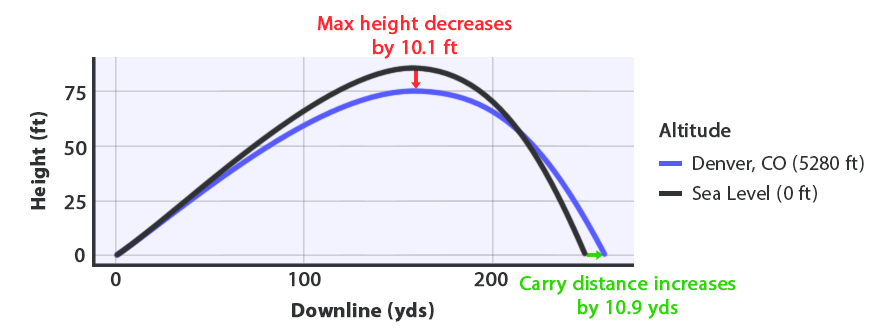
If you’ve ever played in Denver or Mexico City, you know the difference altitude makes. At 5,000 feet, air density drops by about 20%, leading to significantly longer ball flight. One golfer moving from sea-level Florida to Mexico City said his 7-iron started landing on the next hole’s tee box.
Compared to that, humidity’s effect is simply noise.
Practical Adjustment Rule: Focus on Temperature
Given how small humidity’s impact is, most experienced players and coaches recommend ignoring it and focusing on temperature instead.
Use this simple rule: adjust 2.5 yards for every 10°F difference from your normal playing temperature.
Example: If your stock 7-iron carries 160 yards at 70°F, expect:
– 155 yards at 50°F
– 165 yards at 90°F
This accounts for both air density and ball temperature, since colder balls are harder and less lively.
Common Misconceptions About Humid Air
“Humid Air Feels Heavy” Does Not Mean It Is Heavy
Many golfers say humid air “feels heavy,” which leads them to believe it resists ball flight. But that sensation comes from reduced sweat evaporation, not air density. Your body feels sluggish, so you assume the ball does too.
In reality, the air is lighter, but you’re working harder to swing through it.
Desert Distance Comes From Temperature and Elevation, Not Dryness
Balls do fly farther in desert conditions, but not because the air is drier. It’s because:
- Temperatures are higher, which means less dense air
- Ground is firmer, which means more roll
- Courses are often at higher elevation, such as Phoenix or Las Vegas
Dryness itself isn’t the cause. It’s a side effect of the real distance drivers.
Expert Insights: What the Data Says
Marty Jertson’s Research on Weather Factors
Club designer and former Ping executive Marty Jertson has analyzed weather impacts extensively. On podcasts like The Sweet Spot, he confirms that humidity has a measurable but negligible effect on ball flight. Temperature, altitude, and wind are the dominant environmental factors. Player adaptation through grip changes, swing adjustments, and fatigue often outweighs atmospheric changes altogether.
Ideal Gas Law Confirms the Science
Using the formula pV = nRT, experts explain that at constant pressure and temperature, the number of air molecules (n) remains fixed. When lighter H₂O molecules replace heavier N₂ and O₂, mass density drops, even if molecular count stays the same.
However, some note that the drag coefficient (Cd) may vary slightly with air composition. Still, no conclusive data shows this changes flight meaningfully in real-world golf conditions.
When Humidity Actually Matters

Extreme Conditions: Rain and Dew
Once humidity reaches 100% and condensation forms, the game changes significantly:
- A wet ball alters aerodynamics and reduces backspin
- A wet clubface causes slippage and inconsistent contact
- Soggy fairways eliminate roll and increase plugging in soft turf
In these cases, distance loss is real, but it’s due to surface moisture, not air density.
Early Morning Play in Tropical Climates
In Florida, Houston, or Southeast Asia, morning humidity often comes with:
- Cool temperatures
- Dew-covered grass
- Slight player stiffness
Golfers report needing to club up on early approach shots. But again, it’s the combination of cool air and wet conditions, not humidity alone.
One player in Thailand noted using an 8-iron instead of a 9-iron for 115 meters. That adjustment is likely due to lower swing speed, damp turf, and cooler temps, not the humid air itself.
How to Adjust Your Game for Humid Conditions
Prioritize Player Factors Over Physics
Instead of calculating air density, focus on what you can control.
Stay Cool and Hydrated
– Use cooling towels, ice in your hat, and shaded carts
– Drink electrolytes to maintain swing speed
– Play early or late to avoid peak heat index
Check the Real Conditions
– Is the ball dry? Is the turf firm?
– Are you feeling sluggish?
– Is the temperature rising during your round?
Many golfers notice distance gains as the day warms up, even if humidity drops slightly.
Trust Your Yardages, Not the Weather App
– Humidity fluctuations won’t change your 7-iron by more than a few feet
– If you’re hitting it shorter, look at swing quality, fatigue, or moisture first
Frequently Asked Questions About Humidity and Golf
Does humidity make golf balls fly farther?
Technically yes. Humid air is less dense than dry air because water vapor molecules are lighter than the nitrogen and oxygen they replace. However, the actual distance gain is minimal, typically less than 1 yard even at extreme humidity levels.
Why do my drives seem shorter on humid days?
The distance loss usually comes from other factors tied to humid conditions. Cooler morning temperatures, wet grass, and player fatigue from heat all reduce your effective distance more than humidity’s slight air-density benefit can add.
Should I adjust my club selection for humidity?
Most experienced players recommend adjusting for temperature instead. Use the rule of 2.5 yards per 10°F difference from your baseline. Humidity alone rarely warrants a club change.
Does altitude affect golf ball distance more than humidity?
Yes, dramatically so. At 5,000 feet elevation, air density drops about 20%, adding 15 to 20 yards to most shots. Humidity changes typically affect distance by less than 1 yard, making altitude a far more important factor.
Does a wet golf ball travel less far?
Absolutely. Liquid water on the ball or clubface disrupts spin and launch conditions, often causing significant distance loss and accuracy problems. This effect is far more noticeable than humidity in the air itself.
How does heat affect golf performance?
Heat reduces air density, which helps ball flight, but it also causes player fatigue, dehydration, and reduced swing speed. In extreme heat, the negative effects on your body usually outweigh any aerodynamic benefits.
Key Takeaways for Adjusting Your Game in Humid Conditions
Humid air is technically less dense than dry air, so your ball should fly marginally farther in theory. In practice, the effect is so small (less than 1 yard) that you should ignore humidity entirely when planning your shots.
Focus on the factors that actually move the needle. Temperature changes cost or gain you about 2.5 yards per 10°F. Altitude can add 15 to 20 yards at high elevation courses. Wet conditions on the ball, clubface, or turf cause real distance loss through reduced spin and roll.
Your next step on a humid day: check the temperature, not the humidity reading. Adjust your club selection based on how many degrees warmer or cooler it is than your usual playing conditions. Then focus on staying hydrated and swinging smoothly. Your scorecard will thank you.





