

Every golfer has stared down a tight fairway, a crosswind, or a tucked pin and wished for more than a standard swing. Knowing the right golf shot types to deploy in each situation transforms uncertainty into confidence. From controlled fades to high flops and punch shots under tree branches, expanding your shot vocabulary directly lowers scores. This guide breaks down the most essential golf shot types, explains when to use them, and shows how to execute each one with purpose.
You’ll learn how swing path and clubface angle shape the ball, how trajectory adjustments combat wind, and how specialty shots rescue tricky lies. Each section includes setup cues, swing keys, and practical applications so you can take these techniques straight to the course or practice range.
Standard Full Swing Shot Types
Hit a Straight Shot
The straight shot is the foundation of every other golf shot type. Aim your body parallel to the target line, grip the club neutrally, and swing along your shoulder plane. The clubface must arrive square at impact for a true ball flight. Even tour professionals hit shots with slight curvature, so chasing perfection often backfires. Focus instead on minimal deviation and consistent contact. Practice this shot with mid-irons on flat lies to build reliable muscle memory.
Shape a Draw
A draw curves gently from right to left for right-handed golfers (the reverse for lefties). It launches lower than a fade, produces more roll after landing, and often adds total distance. To hit a draw, close your stance slightly so your feet, hips, and shoulders point right of the target, then aim the clubface at the target. Swing along your body line while letting the clubface close through impact. This inside-out path with a slightly closed face creates the right-to-left spin. Use a draw for extra yardage or to bend the ball around obstacles blocking a direct line.
Play a Fade Shot
A fade curves softly from left to right for right-handed golfers and is famous for its consistency and predictable landings. Set your body alignment left of the target while keeping the clubface pointed at the target. This leaves the face open relative to your path. Swing along your body line (left of target) to produce an outside-in swing path. The resulting left-to-right spin helps the ball stop quickly on firm greens. Fades work well in windy conditions, around doglegs, or when you need a safe, controlled shape.
Short Game Shot Types
Execute a Chip Shot
A chip is a low-trajectory shot played from just off the green, with most of the distance covered by roll rather than carry. Use a wedge, 8-iron, or 9-iron depending on how much roll you want. Position the ball back in your stance, keep your hands ahead of the clubhead, and make a compact pendulum stroke with minimal wrist hinge. Let the club’s loft launch the ball into the air. This shot excels when you have an open path to the hole and firm turf. Choose a higher-lofted club for more carry and a lower-lofted club for more rollout.
Master the Pitch Shot
A pitch flies high, lands softly, and covers 20–50 yards with limited roll. Use a sand wedge or lob wedge with an open stance and a slightly open clubface. Place the ball forward in your stance and make a full swing with a pronounced wrist hinge. Allow the club to release fully through impact for crisp contact. The high backspin stops the ball quickly on tight pins. Vary swing length to control distance without switching clubs, making this one of the most versatile scoring golf shot types.
Try the Flop Shot
The flop is an advanced, high-arcing shot loaded with backspin, designed to fly over bunkers, thick rough, or closely mown areas. Use a lob wedge with 60° or more of loft and open the clubface dramatically at address. Place the ball well forward, shift weight to your back foot, and make a steep swing while keeping your wrists relaxed. The open face and steep attack angle generate maximum height and spin. Precision is critical because mishits skull the ball or leave it fatally short. Deploy this shot only when a safer alternative doesn’t exist.
Specialty and Recovery Shot Types

Play a Punch Shot
A punch shot flies low and pierces through wind or tree canopies. Use a 7-iron or 8-iron, position the ball back in your stance, and keep your hands slightly ahead of the clubhead. Make a controlled three-quarter swing with limited wrist hinge, focusing on a clean downward strike. The low trajectory reduces spin and wind drift. This shot gives you control when high flights become unpredictable.
Hit a Knockdown Shot
The knockdown is a punch shot with a fuller swing, producing a lower flight that carries close to normal distance. Choke down on the grip of a mid-iron and swing smoothly with a shortened follow-through. Keep your body stable and centered over the ball. Knockdowns are perfect for long approaches into a headwind. They require precise timing because over-swinging often costs significant yardage.
Escape With a Greenside Bunker Shot
Greenside bunkers demand a sand wedge with 54°–56° of loft. Open your stance and clubface, then anchor your feet in the sand for stability. Position the ball forward and swing along your body line, striking the sand 1–2 inches behind the ball. The wedge’s bounce slides under the ball and lifts it out. Trust the loft; never try to scoop. Confidence and commitment separate consistent bunker players from frustrated ones.
Shot Shapes for Course Management
Curve the Ball Intentionally
Intentional shot shaping lets you attack pins hidden behind hazards or follow curving fairways. A draw helps when the right side of the green is open; a fade works when the left side is accessible. The relationship between path and face angle controls curve: an in-to-out path with a closed face draws the ball, while an out-to-in path with an open face fades it. Use alignment sticks during practice to visualize and groove these paths until the shot becomes automatic.
Adjust for Wind Conditions
Wind dramatically alters ball flight, making smart golf shot types critical for scoring. In a headwind, hit a knockdown or punch to minimize airtime. In a tailwind, play a normal shot to maximize carry. Into a crosswind, shape the ball into the wind because a headwind component stabilizes curved flights. Choose lower-lofted clubs for punch shots and tee the ball lower to keep launch height down. These adjustments preserve both distance and direction.
Navigate Dogleg Holes
Doglegs reward golfers who shape shots on purpose. On a dogleg left, a right-handed player can use a draw to follow the fairway curve. On a dogleg right, a fade traces the hole’s bend. When unsure, hit straight and let your natural shot bias guide the ball. Pick an intermediate target like a tree or bunker edge to fine-tune alignment. The goal is positioning, not raw distance.
High and Low Trajectory Shot Types
Hit a High Lob Shot
A high lob maximizes carry and minimizes rollout, perfect for soft greens and tight pin positions. Use a lob wedge with an open clubface and ball positioned forward. Make a full wristy swing with aggressive release through impact while keeping your weight balanced. The ball climbs steeply, lands softly, and stops almost vertically. This is one of the most useful scoring golf shot types when you need precision over power.
Play a Low Runner Shot
A low runner is essentially a long chip that skips and rolls toward the target. Use a 7- or 8-iron with the ball at a neutral or slightly back position. Keep your hands ahead and stroke with a putting-like motion, adding just enough loft to clear the grass. The ball pops up briefly and then rolls predictably. This shot mimics putting behavior, making it ideal on firm ground with clear paths to the hole.
Special Lies and Situations
Hit From a Fairway Bunker
Fairway bunkers require clean ball-first contact. Use one less club than usual to compensate for the ball sitting up in the lie. Position the ball slightly back in your stance and deliver a descending blow. Avoid the common mistake of decelerating; commit to a full, balanced swing. If the ball is buried, choose a conservative escape rather than a risky hero shot.
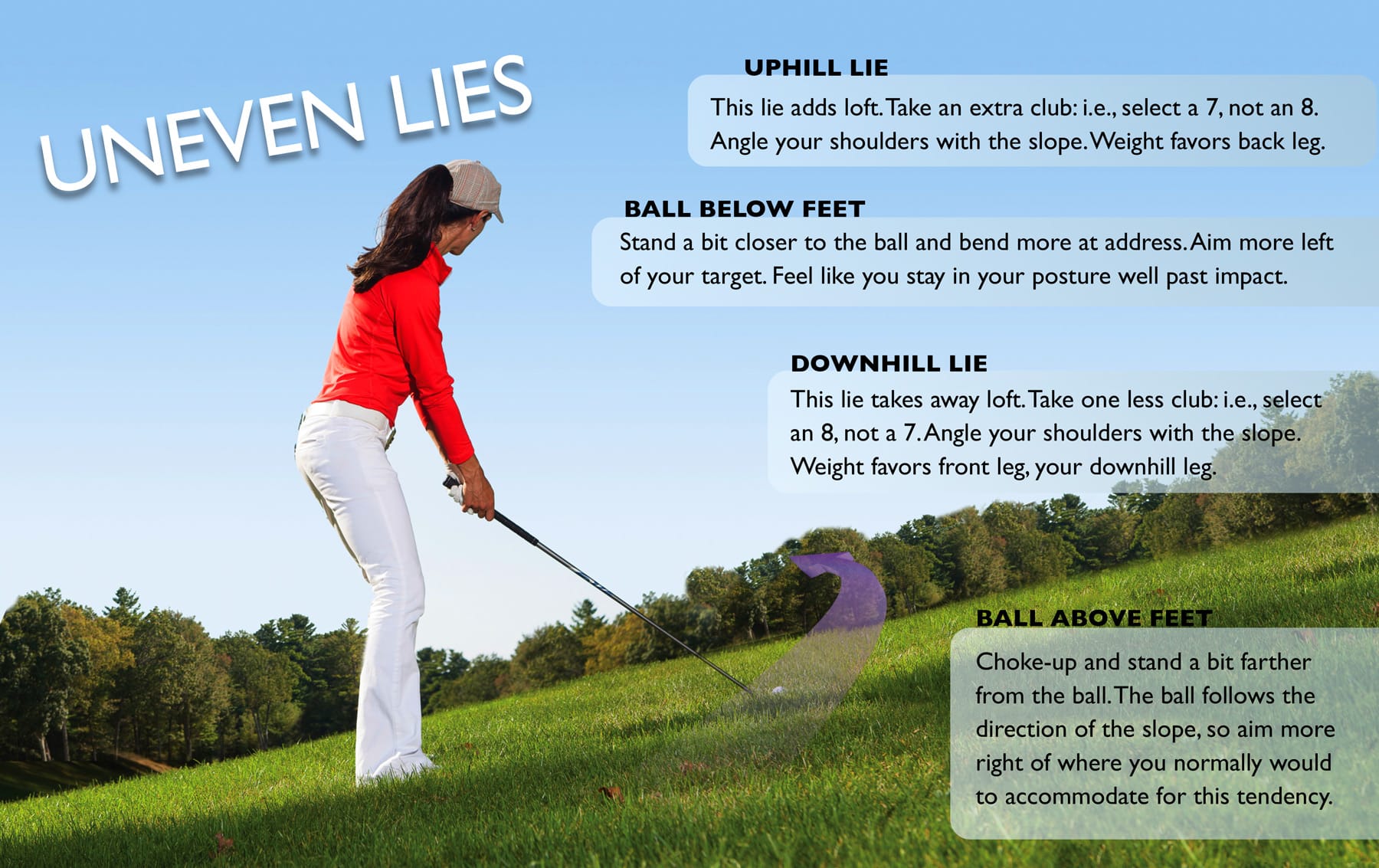
Play a Ball Above Your Feet
When the ball rests above your feet, it tends to pull left (for right-handed golfers) because the swing arc flattens against the slope. Aim right to compensate, bend more from the hips, and swing smoothly to stay balanced. Expect a higher, shorter flight, so consider gripping down or taking one less club. Practice this lie to build confidence on sloped fairways.
Hit From a Downhill Lie
A downhill lie produces a low, left-curving shot for right-handed golfers. Match your shoulders to the slope, set the ball slightly back in your stance, and favor your front foot. Take more club because loft is reduced and distance suffers. Stay behind the ball through impact and avoid sliding forward. Balance and solid contact are non-negotiable on this challenging lie.
Practice and Shot Selection Tips
Build a Pre-Shot Routine
A repeatable pre-shot routine sharpens focus and execution. Pick a target, select an intermediate aiming point, take a rehearsal swing, and visualize the flight. Step in, align, and commit fully. This routine applies to every golf shot type, from drives to delicate chips, and reduces indecision under pressure.
Use the Right Club for the Shot
Every club has a designed purpose, and forcing a club to perform outside its strengths leads to poor results. Mid-irons excel for punch and knockdown shots. Wedges and lob wedges handle high short-game trajectories. Drivers maximize distance off the tee. Match the shot to the club’s natural strengths and learn your personal yardages for each.
Practice Shot Variety Weekly
Most golfers only practice full swings, but well-rounded practice unlocks scoring. Dedicate 20 minutes to short-game variety with multiple clubs. Spend another 15 minutes on pitch distance control. Add drawn and faded 7-iron reps to build shot-shaping reliability. Simulate uneven lies and recovery shots regularly. A wider shot vocabulary translates directly to lower scores.
Avoid Common Shot-Making Mistakes
Frequent errors include over-swinging on pitch shots, decelerating in bunkers, and poor alignment on shaped shots. Maintain rhythm and balance on every swing. Let the club’s loft lift the ball rather than scooping with your wrists. On recovery shots, prioritize contact over result. When confidence wavers, play the safe option and advance the ball into play.
Frequently Asked Questions About Golf Shot Types
What Are the Basic Golf Shot Types Every Beginner Should Learn?
Every beginner should first master the straight shot, basic chip, and standard pitch. These three golf shot types cover the majority of on-course situations and build a foundation for more advanced techniques like draws and fades.
How Do You Shape a Draw vs. a Fade?
A draw requires an inside-out swing path with a slightly closed clubface relative to that path. A fade requires an outside-in path with an open clubface relative to the path. Adjust your stance and aim to influence the swing direction while keeping the face angled toward the target.
Which Golf Shot Types Work Best in Windy Conditions?
In windy weather, choose low-trajectory golf shot types such as the punch and knockdown. These reduce airtime and minimize wind drift. Shaping the ball into a crosswind also adds stability to the flight.
What Is the Difference Between a Chip and a Pitch?
A chip is a low shot with most distance covered by roll, played with minimal wrist hinge. A pitch flies higher, lands softer, and uses more wrist action for greater carry. Chips work on firm ground with clear paths, while pitches handle obstacles and tight pins.
When Should You Use a Flop Shot?
Use a flop shot only when you must carry an obstacle like deep rough or a bunker with little green to land on. It is a high-risk, high-reward option best reserved for skilled players who can execute it consistently under pressure.
How Can You Practice Different Golf Shot Types Efficiently?
Set up a structured practice plan that includes short-game reps, shape shots with mid-irons, and recovery simulations from uneven lies. Tracking which golf shot types you practice ensures balanced development and prevents stagnation.
Key Takeaways for Mastering Golf Shot Types
Mastering golf shot types shifts your approach from reactive swing hoping to strategic, intentional play. Start with fundamentals like the straight shot, chip, and pitch before progressing to shaped full swings and specialty recoveries. Practice deliberately, learn your preferred shot shapes, and adjust based on conditions and course design.
Your next step is simple: pick two golf shot types from this guide you have not yet attempted and dedicate the next practice session to executing them on the range. Repeat this weekly, and your confidence on the course will grow with every new shot you add to your arsenal.





