

Putting looks simple, yet it frustrates most amateur golfers week after week. The problem usually isn’t your stroke mechanics or how many hours you practice. The real culprit is an inconsistent golf putter set up that changes from putt to putt. When your address position shifts, your results shift with it.
This guide breaks down a proven four-step system that builds accuracy into your stance. You will learn how to align the face, lock your arms, load your lead side, and let your shoulders do the work. By the end, you will have a repeatable routine you can trust on every green.
Square the Putter Face to Your Target Line First

Your putt begins the instant you settle over the ball. The very first thing you must do is aim the putter face toward your starting line, not the hole itself. For breaking putts, such as a right-to-left slider, aim two to three feet right of the cup to give the ball room to curve back toward the hole.
Visual aids make this step easier. If your putter has alignment lines, use them as a reference. You can also lay a club on the turf along the intended path, then square your putter face to it. This second check removes optical illusions.
Why Face Alignment Drives Starting Line Accuracy
- Face angle at impact accounts for most of your starting line direction
- A small misaim of just 2 degrees can push a 10-foot putt several inches off target
- Your eyes naturally misjudge straight lines, especially under pressure
Pick a point six to twelve inches in front of the ball on your target line. Align the face to that spot rather than the distant hole. A close reference is easier to focus on and helps your brain lock in the right direction.
Lock the Putter Shaft in Line with Your Lead Forearm
After aiming, you need to create a stable connection between your body and the putter. For right-handed golfers, this means aligning the shaft with your left forearm. The two should form a single straight line from your elbow down through the grip.
When this alignment is correct, the putter swings on a natural arc without extra effort. You stop fighting to keep the face square during the stroke. The geometry of your arms and the club does that work for you.
How to Verify Shaft and Forearm Alignment
- Grip the putter with both hands in your normal position
- Let your arms hang relaxed from your shoulders
- Check your peripheral vision. The shaft should appear to extend straight up your lead forearm
- Adjust your grip height or distance from the ball if the shaft angles up or down
A locked position also keeps your eyes properly positioned. Standing too close or too far from the ball breaks this alignment. Your eyes should sit directly over the ball or just inside it, with arms hanging freely.
Load the Putter Forward Into Your Lead Arm
With the shaft locked, gently shift the putter forward in your lead hand. The grip moves slightly toward the target until the shaft sits snug against your left forearm for right-handed players. This forward press is subtle, not aggressive. It creates light tension without forcing.
This loaded position does two important things for your golf putter set up. First, it keeps the face square as you take the putter back. Second, it prevents your hands from dominating the stroke, which eliminates flipping or rolling at impact.
What the Load Should Feel Like in Your Hands
- Slight firmness through the lead forearm
- Putter head stays low and wide on the backstroke
- The trail hand feels passive and relaxed
- Shoulders, not hands, drive every movement
A common mistake is skipping this load phase entirely. Without it, the face tends to open during the takeaway, which sends the ball off line before it even leaves the sweet spot.
Let Your Shoulders Power the Stroke
Now it is time to swing, and your shoulders should be the only engine. Keep your wrists firm, your hands quiet, and rotate your lead shoulder to pull the putter back and through. This creates a natural pendulum that follows the path your setup established.
Because your aim, lock, and load are already in place, the putter traces a consistent arc without manipulation. It starts back on the target line, moves in a slight arc, and returns straight through impact.
Why Shoulder Rotation Beats Hand Action
- Active hands rotate the face and ruin aim
- Wrist breakdown changes loft and ruins distance control
- Hand-driven strokes break down under pressure on short putts
Instead of trying to hit the putt, focus on releasing it with your shoulders. The motion becomes smoother, more rhythmic, and far easier to repeat. Practice strokes without a ball to groove this feeling before bringing it to real putts.
Build the Right Stance and Posture to Support Your Setup
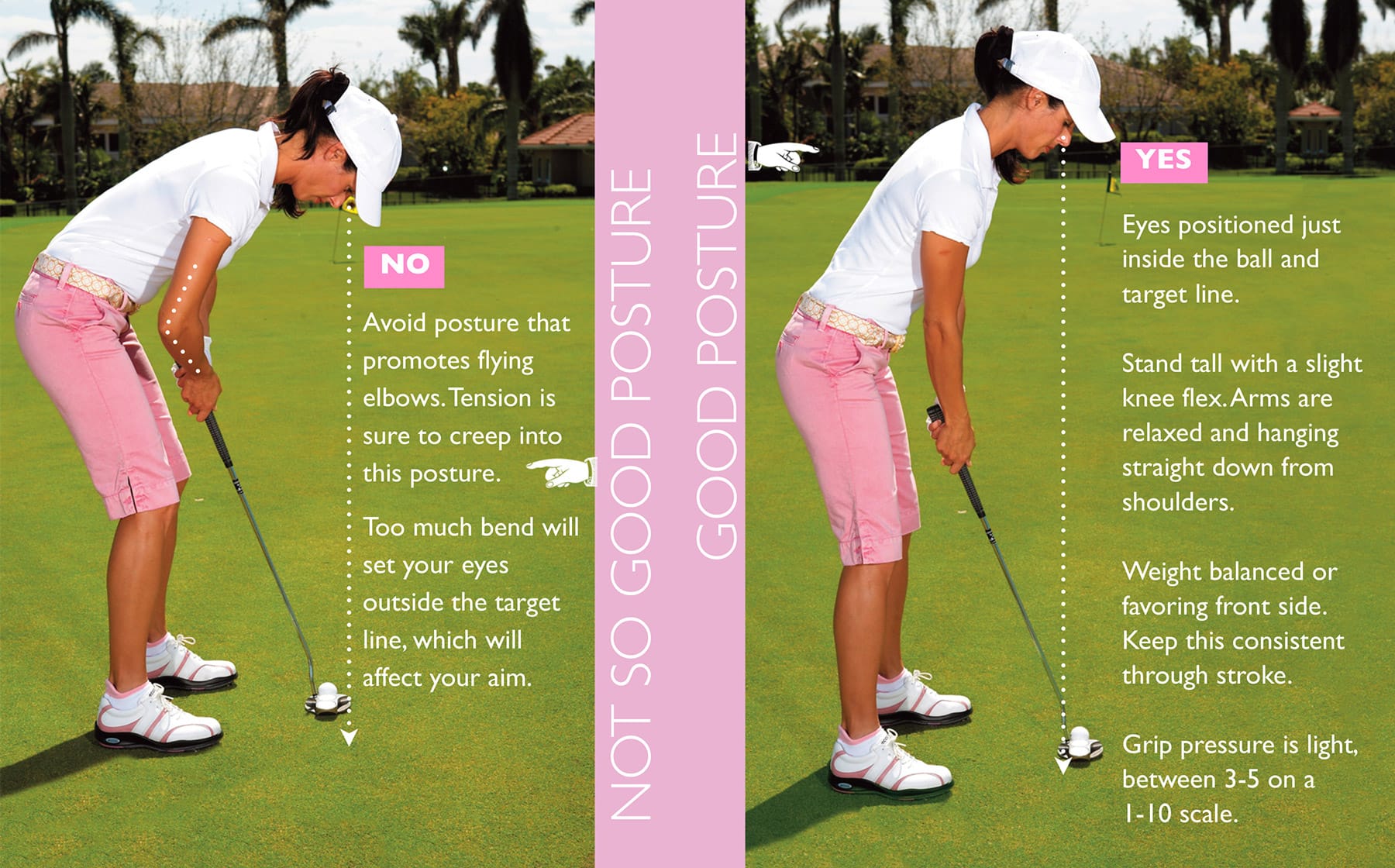
Your setup begins from the ground up, so your stance and posture matter just as much as your grip and alignment. A balanced, athletic position lets your shoulders rotate freely and keeps your eyes steady over the ball.
Ideal Putting Stance Essentials
- Feet placed shoulder-width apart
- Knees softly bent for stability
- Weight centered over the balls of your feet
- Shoulders square and parallel to your target line
Proper Posture for a Pendulum Stroke
- Spine tilted forward from the hips, not the waist
- Arms hanging naturally from the shoulders
- Eyes directly over or slightly inside the golf ball
A good visual cue is the ball drop test. If you drop a ball from your eyes, it should land on the golf ball or just inside it. Slouching or standing too upright breaks this position and restricts your shoulder turn.
Fix the Most Common Setup Mistakes That Ruin Putts

Even small errors in your golf putter set up cause big problems on the greens. Here is how to spot and correct the most frequent mistakes.
Putter Face Aimed Off Line
Symptom: Ball starts offline the moment you strike it
Fix: Use alignment lines on the putter plus a ground rod to verify aim
Check: Look from behind the ball. The face should appear square to your line
Shaft Misaligned with Lead Forearm
Symptom: Face angle changes during the stroke, hands flip at impact
Fix: Adjust your distance from the ball or grip height until the shaft runs straight into the forearm
Check: Look down at address. The shaft should visually extend into your lead arm
Missing the Forward Load
Symptom: Putter face opens on the takeaway
Fix: Apply a subtle forward press at address so the shaft rests against the lead arm
Check: Your trail hand should sit slightly lower than your lead hand at address
Hands Dominating the Stroke
Symptom: Jerky tempo, poor distance control on lag putts
Fix: Focus purely on shoulder rotation and lock the wrists
Check: Record your stroke on video. The hands should never move independently of the arms
Drill the Setup in Just Five Minutes Before You Play
You don’t need long practice sessions to build a repeatable golf putter set up. Spend five minutes running through this sequence before every round to reset your muscle memory.
- Aim. Lay a club or alignment rod on the ground. Square the putter face to it.
- Lock. Check the shaft and forearm line in a mirror or against a window. Adjust until they align.
- Load. Press the grip slightly forward. Feel the shaft settle into your lead arm.
- Go. Make ten shoulder-driven strokes without a ball. Focus only on rhythm and arc.
- Repeat with a ball. Hit ten putts, concentrating solely on holding your setup.
This short routine locks in the feel of a proper address position so you can take it to the course with confidence.
Choose Putter Styles That Match This System
Not every putter supports this setup equally. Some designs encourage hand manipulation, while others promote stability and alignment.
Putter Types That Work Best
- Mallet putters offer high MOI and built-in alignment aids
- Face-balanced putters resist twisting and suit slight arc strokes
- Alignment track putters give clear visual feedback for aim
Styles to Approach with Caution
- Strong toe-hang putters require more hand rotation to square the face
- Putters with poor or missing alignment markings force guesswork on every putt
If you currently use a blade putter, make sure it matches your stroke type. Face-balanced or low-toe-hang models pair best with this system.
Build a Pre-Putt Routine That Locks In Confidence
The best putters in the world share one trait. They trust a routine. When your setup is automatic, your mind stays calm, and you stop second-guessing yourself over the ball.
Build a simple pre-putt checklist that includes:
- Reading the green from behind and from the low side
- Marking your line on the golf ball
- Walking into your stance and committing to Aim, Lock, Load, Go
- Trusting your setup and stroking the putt without hesitation
On short putts, avoid looking at the hole after you set up. Trust your aim and let your shoulders take over.
Frequently Asked Questions About Golf Putter Setup
What Is the Most Important Part of a Golf Putter Setup?
The most important part is aligning the putter face to your target line before anything else. Even a perfect stroke cannot save a putt that starts offline. Aim first, then build your posture and grip around that alignment.
How Far Should I Stand From the Ball When Putting?
Stand so your arms hang naturally from your shoulders with a slight bend at the elbows. Your eyes should sit directly over the ball or just inside it. This distance keeps the shaft aligned with your lead forearm and promotes a stable pendulum stroke.
Should I Use a Forward Press in My Putting Setup?
Yes, a subtle forward press helps lock the putter into your lead arm. It reduces face rotation during the takeaway and keeps your hands quiet through impact. Just be careful not to press too aggressively, which can disrupt your alignment.
How Do I Stop Using My Hands Too Much in Putting?
Focus on rotating your shoulders rather than pushing with your hands. Practice strokes without a ball and pay attention to keeping your wrists firm. Recording your stroke on video also reveals hand dominance so you can correct it.
What Type of Putter Is Best for a Straight-Back-Straight-Through Stroke?
Face-balanced mallet putters work best for this stroke type. They resist twisting on off-center hits and keep the face square throughout the stroke. Putters with clear alignment lines also help you start the ball on your intended line.
How Long Does It Take to Build a Consistent Putting Setup?
Most golfers see improvement within a few practice sessions if they follow a structured routine. Spend five minutes on the setup sequence before each round for two to three weeks. The repetition builds muscle memory quickly.
Final Thoughts on Building a Consistent Golf Putter Setup
Better putting starts before you ever swing the club. A golf putter set up built on Aim, Lock, Load, and Go takes the guesswork out of putting. You stop relying on hand-eye coordination alone and start trusting your setup.
When you square the face, lock the shaft to your forearm, load the putter into your lead arm, and swing with your shoulders, your stroke becomes repeatable. The face stays square. The path stays true. The ball starts on line.
Stop overcomplicating your putting stroke. Focus on the setup, trust the process, and watch your confidence grow on every green.





